Pre-installation
Working With CAT5 Fluids? How To Boost Water Pressure Without Risking Backflow Contamination
Understanding the TankBoost CAT5 variant, and when to install
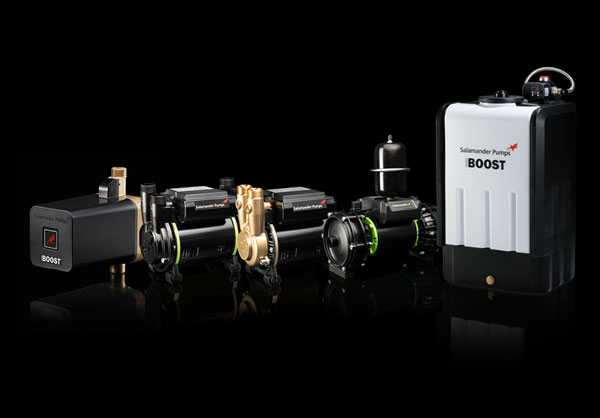
Salamander Pumps’ TankBoost units combine a storage tank and integrated submersible pump to boost water pressure and flow in a mains-fed system, helping meet demand in the property.
The range includes different options capable of boosting the pressure and flow up to 3.0 bar and 80 L/min, or 5.0 bar and 120 L/min for larger/taller buildings, where greater pressure is needed to overcome inevitable pressure loss across greater pipe distances and up additional floors.
We have also developed a CAT5 variant, which operates the same as a standard TankBoost but with greater backflow protection, suitable for installations dealing with CAT5 fluids.
Here we explore the differences between CAT5 and standard models, explain how the CAT5 unit works, and set out exactly when to use CAT5 TankBoost models – and when not to.
Understanding fluid categories – what is CAT5?
Under the Water Supply (Water Fittings) Regulations 1999 in England and Wales, fluids are classified into five categories according to the level of health risk they could pose if they were to flow back and contaminate the water supply. Equivalent requirements apply under the relevant water fittings regulations in Scotland and Northern Ireland too.
There are five fluid categories, ranging from Category 1, which is wholesome water supplied for drinking, through to Category 5, which represents the highest risk classification. These are based on the nature and severity of the potential contamination, including factors such as toxicity, microbiological contamination and the presence of other substances that could pose a danger to human health.
CAT5 (Category 5) fluids are those which pose a serious public health risk due to high concentrations of highest pathogens, radioactive materials or toxic chemicals. This could include water containing human waste, viruses and bacteria, or heavy chemicals – fluids which could pose a serious risk to health if they contaminate the mains. It is therefore vital that additional protections are put into place to prevent backflow of CAT5 contaminants in these systems, which are typically found in commercial environments such as abattoirs, agricultural wash-down areas, hospital mortuaries, commercial bin stores, laboratories and veterinary surgeries.
If you need further advice on CAT5, you can seek guidance for free from the local water undertaker in your area.
How are TankBoost CAT5 units different?
TankBoost CAT5 uses a Type AB air gap and weir-type overflow to provide protection against / prevent contamination from high risk category 5 fluids
Mains water enters the TankBoost inlet where a ball valve is installed to control the water level. This inlet is positioned above the stored water, creating an air gap between the mains supply and the tank’s stored water.
If the ball valve fails and/or there is backflow contamination and the water level continues to rise, excess water is discharged through the weir-type overflow. This prevents water from rising back towards the mains inlet and protects the mains water supply from backflow contamination. CAT5 variants also use a different ball valve arm to standard models, which helps to maintain a greater air gap.
In addition, TankBoost CAT5 has an outlet overflow for further protection. You can read more about understanding backflow regulations in the UK here.
Installers should adjust the ball valve height so that when the valve is closer, the water level is at least 10mm below the weir overflow.
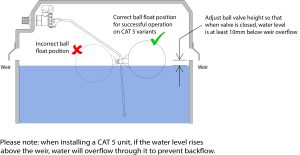
CAT5 variants are available for all sizes (3.0 bar – 100L, 200L, 350L and 450L / 5.0 bar – 200L, 350L and 450L), and additional units can be linked for extra capacity if needed.
Installation considerations
Before starting any TankBoost installation, it’s important to read the Installation Guide.
CAT5 models are largely intended for use in commercial applications – they are not required for typical domestic installations. They are ideal for sites handling fluids that pose a serious health hazard, including laboratories, chemical cleaners/contractors, butchery and meat trades, healthcare premises, abattoirs, dog grooming parlours and bin wash down areas for flats. It’s all about preventing backflow contamination, when dealing with CAT5 fluid.
In particular, it’s vital that installers understand water will exit via the overflow when it rises above the weir, to prevent the risk of backflow. For this reason, CAT5 variants should only be installed in spaces where there is no risk that water will cause damage to the property – and especially not in loft spaces. This is an important consideration, because the majority of errors relating to CAT5 installations occur when a CAT5 variant is not needed for the application and has been incorrectly installed in a loft.


